







当前位置: 首页 > 主营项目 > 试剂盒 > qPCR 用cDNA参照

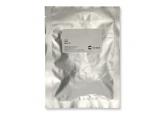
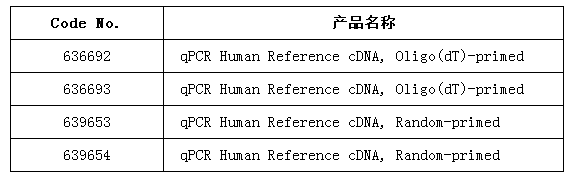
qPCR 用cDNA参照 品牌 Code No. 包装量 价格 Clontech 636692 25 Rxns 952 元 Clontech 636693 100 Rxns 2,845 元 Clontech 639653 25 Rxns 952 元 Clontech 639654 100 Rxns 2,845 元
Reference cDNA for Real-Time qPCR
Measurements of mRNA expression levels—whether by Northern analysis, ribonuclease protection, or real-time quantitative PCR—are usually standardized by comparing the data to that obtained for an internal or endogenous reference gene. Housekeeping genes such as beta-actin and glyceraldehyde-3-phosphate dehydrogenase (GAPDH) are most often used because their expression levels are expected to remain constant under different treatment conditions. Unfortunately, this assumption is not always valid, and results based on housekeeping genes alone can be biased (1). A better method is to normalize your data using our qPCR Human Reference cDNA, the only total cDNA control derived entirely from human tissues (2).
qPCR Human Reference cDNA is the ideal control for comparing data from different quantitative PCR (qPCR) experiments. Because it is prepared from a total RNA pool collected from several different tissues, our qPCR Human Reference cDNA provides broad gene coverage, as shown by microarray analysis of the RNA starting material. RNA, and therefore cDNA, prepared from whole tissues provides better gene representation with less variation than RNA made from cell lines (data not shown). Moreover, PCR analysis shows that our Total RNA is virtually free of genomic DNA (3). This allows for a more accurate measurement of transcript copy number. Both high and low abundance genes are well represented allowing preparation of a wide range of serially diluted standards for each qPCR assay. Lot-to-lot variation of Reference cDNA is minimal because the RNA source is prepared on an industrial scale.
Product image
High-, medium- and low-abundance gene targets are easily detected in qPCR Human Reference cDNA. Oligo dT-primed (Panels A–C) and random oligo-primed (Panels D–F) qPCR Human Reference cDNA samples were each serially diluted fivefold such that the final quantities of cDNA template in the qPCR reactions were 20 ng, 4 ng, 800 pg, 160 pg, 32 pg,and 6.4 pg. Data were obtained on a Stratagene Mx3000P real-time PCR instrument. The primer sets for all three genes demonstrate the ability to detect a wide range of signals from the serially diluted samples. PPIA = peptidylprolyl isomerase A (cyclophilin A; high-abundance); HPRT = hypoxanthine phosphoribosyltransferase I (medium-abundance); PBGD = porphobilinogen deaminase (low-abundance). Slope and R2 values refer to the line determinedby plotting Ct values versus template quantity.
 Global - English
 China - 中文
 Brasil - Português
 France - Français
 Germany - Deutsch
 Hungary - Magyarország
 Italy - Italiano
 Japan -日本语
 Russia - Россия
 United States - English

